(This exercise is taken from 'Free-Range Writing', by Jenny Alexander.)
What's it about?
Friday, 8 January 2021
Feeling bad, feeling better...
Thursday, 31 December 2020
Fantasy travel
I think it's time for a bit of fantasy travelling, a bit of escapism - so let's go!
Below are three postcards. You can use one of these as a starting point for a story or imaginative piece of some kind - or you can use a picture of your own and simply write about the place.
You might want to start by describing what you see, but it's entirely up to you!
![]() |
| The Torre Guinigi in Lucca, Tuscany |
![]() |
| Tenerife, from a painting by Marianne North |
![]() |
| From a painting by James Lynch |
Saturday, 5 December 2020
A poem in winter
Just in case anyone has spotted the word 'poem' and has a bad case of sinking heart, panic not! As far as I'm concerned, a poem is just a short piece of writing, arranged in short lines, with a certain pattern to the rhythm. It can have rhyme, but that's not essential.
There! That's not so bad, is it? Of course, like everything else, as you get further in, it can get more complicated, with talk of sonnets and sestinas and suchlike, but that's the basis of it: a short piece of writing on a theme of your choice.
And our theme this week is 'Winter'. This gives you huge scope, and as ever, I'd suggest a spider chart - jot down all the different aspects and thoughts and feelings that come to mind. You might be drawn to writing about nature, or about a memory, or about winter food or clothes, or about weather, or the sea in winter, or how new growth begins in the garden - the possibilities are endless.
Here are a couple to get you into the zone. First, a very beautiful one by Christina Rosetti, which you will recognise. The second is a contemorary poem by Kathleen Jamie.
In the Bleak Mid-winter
In the bleak mid-winter
Frosty wind made moan
Earth stood hard as iron
Water like a stone;
Snow had fallen, snow on snow
Snow on snow
In the bleak mid-winter
Long ago.
It was winter, near freezing,
I'd walked through a forest of firs
when I saw issue out of the waterfall
a solitary bird.
It lit on a damp rock,
and, as water swept stupidly on,
wrung from its own throat
supple, undammable song.
It isn't mine to give.
I can't coax this bird to my hand
that knows the depth of the river
yet sings of it on land.
Friday, 27 November 2020
Christmas Writing
I was going to present you with some images of Christmas as a starting point for writing - but when I googled Christmas, none of the images that came up really seemed to represent Christmas for me. Though I did like this one!)
So I decided instead to look for some writing that I hope will inspire you. First, here's a poem by U A Fanthorpe.
BC : AD
This was the moment when Before
Turned into After, and the future's
Uninvented timekeepers presented Arms.
This was the moment when nothing
Happened. Only dull peace
Sprawled boringly over the earth.
This was the moment when even energetic Romans
Could find nothing better to do
Than counting heads in remote provinces.
And this was the moment
When a few farm workers and three
Members of an obscure Persian sect
Walked haphazard by starlight straight
Into the kingdom of heaven.
*****
And in a very different mood, this comes from The Country Child, by Alison Uttley. This book is about a year in the life of a little girl living on a Derbyshire farm at the end of the 19th century. There's a whole chapter on Christmas, full of the most delicious things, but this bit is from the beginning.
Christmas Day
Susan awoke in the dark of Christmas morning. A weight lay on her feet, and she moved her toes up and down. She sat up and rubbed her eyes. It was Christmas Day. She stretched out her hands and found the knobby little stocking, which she brought into bed with her and clasped tightly in her arms as she fell asleep again.
She awoke later and lay holding her happiness, enjoying the moment. The light was dim, but the heavy mass of the chest of drawers stood out against the pale walls, all blue like the snow shadows outside. She drew her curtains and looked out at the starry sky. She listened for the bells of the sleigh, but no sound came through the stillness except the screech-owl's call.
Again she hadn't caught Santa Claus. Of course she knew he wasn't real, but also she knew he was. It was the same with everything. People said things were not alive, but you knew in your heart they were: statues which would catch you if you turned your back were made of stone; Santa Claus was your father and mother; the stuffed fox died long ago.*
*(The stuffed fox was something she saw on her way to bed every night, which she was afraid of.)
Some suggestions for getting started:
Get a biggish piece of plain paper and make a spider chart - put down, without thinking too much, all the ideas, memories and things you associate with Chistmas. Circle the ones that stand out.
- Consider: would they fit a poem best, or a short story, or a memoir/reflective piece? If you're stuck - how about taking one of the lesser figures in the Bible story, or just an onlooker, and telling the rather unlikely story from their point of view, eiter as a poem or as a story?
- Or, think back to a Christmas you've experienced, which was memorable in some way, either good or bad: the turkey that wasn't cooked, the storm that caused a power cut, the relations who didn't get on... the first Christmas in a new house or in a foreign country.
- Or go for a children's story - make it magical or funny: the elf that fell out with Santa, the new-fangled motorised sleigh that put Rudolph out of business. Or make it darker: the present you wanted so much but didn't get, the Christmas play that went all wrong, the arguments that marred the big day. Or simply think back to your childhood Christmases.
| Illustration by C F Tunnicliffe from 'The Country Child'. |
Thursday, 19 November 2020
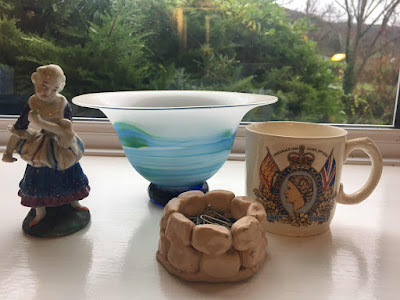
Pick an object - any object!
Thursday, 12 November 2020
Life stages
This week's task is taken (slightly adapted) from the October edition of the Writing Magazine.
Imagine a main character that you want to write about. Then ask yourself how they would have reacted to various circumstances or challenges at different stages of their life. You can choose what ages to use, but some suggestions are:
- Small child
- Teenager
- Person in their twenties
- Elderly person
Then think about how they would have dealt with these events at those different ages (or you can choose a different one if you prefer):
- Death of a pet
- Moving house
- Falling out with a friend
- Witnessing a car crash
Then you could write a series of self-contained but linked stories with your character at a different age in each one.
OR, just as good, rather than making it up, you could write from life.
Thursday, 5 November 2020
NB It should be no more than 600 words.
Below is a list of a dozen words. Write your story incorporating at least 5 of the words in any way you like. Please give your story a catchy title and submit it by email as an attachment (sorry, no hard copies) by December 2nd. The plan is to publish 100 copies and price them at £5 which includes post and packing as well as a donation to one of our favourite charities, Young Carers. (Google to find out more about them)
Please note this project is suitable for beginners and experienced writers and our mission is to keep your creativity flowing during lockdown.
A couple of tips: Avoid cliches, check spelling and word count and try for a story arc.
Here is the list of words – remember to use a minimum of 5:
Bluebottle, Clock, Fur, Lavender, Train, Ella Fitzgerald, Nylon shirt, High heels,
Seaweed, Turpentine, Burnt Toast, Bonfire
-
Haiku is a Japanese form of poetry which dates back over a thousand years. I imagine (probably quite wrongly) the ladies and gentlemen of t...
-
Monet - Gare St Lazaire Sisley - The Road Monet - The Beach at Trouville Choose one of the pictures, and use it as a starting point for a ...
-
For this task, begin by thinking of a house, or maybe just a room you remember: or you could choose a workplace or an office - anywhere, re...